
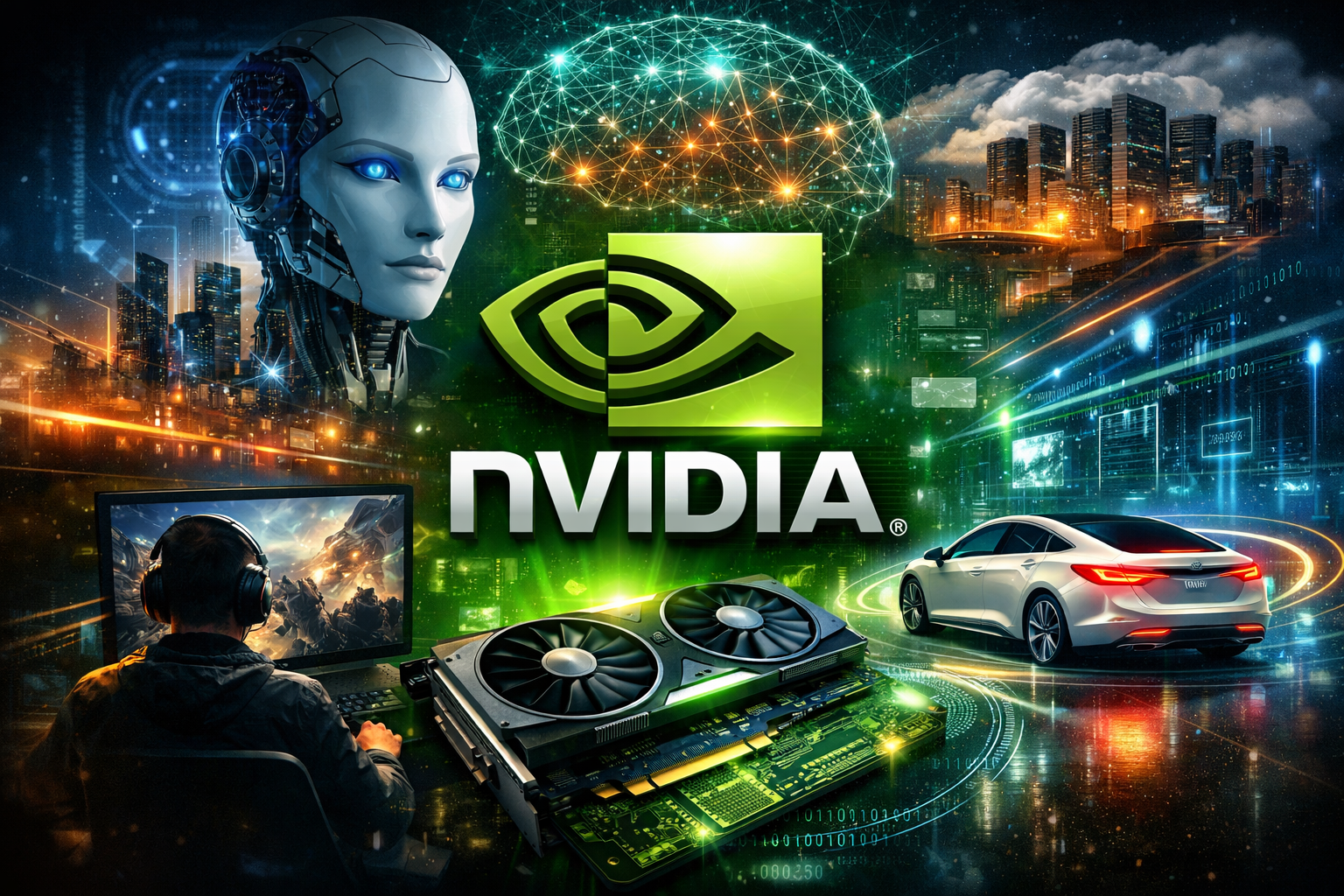
Nvidia powers AI, gaming, and next-generation technology. Learn what Nvidia does, why it matters, and how its innovations are shaping the future. Nvidia is everywhere — even if you’ve never heard of it. From the graphics in your favorite video game to the artificial intelligence (AI) models shaping our future, Nvidia’s technology makes it all happen. But what exactly is Nvidia, why does it matter, and where is it headed next? In this blog post, we’ll break it all down in plain language — no tech-nerd dictionary needed.
You’ll learn:
- What Nvidia actually does
- How it went from a tiny startup to a global powerhouse
- Why it’s central to AI, gaming, robotics, and more
- New innovations shaping its future
Let’s get started!
Who Is Nvidia? A Simple Explanation
At its core, Nvidia is a semiconductor company — that means it designs tiny chips that make computers faster and smarter. These chips are especially good at handling graphics and complex calculations that regular computer brains (CPUs) struggle with. (Wikipedia)
While Nvidia is best known for graphics cards, it has expanded far beyond gaming. Today, its technology drives:
- AI systems, like the ones behind ChatGPT
- Data centers that run large-scale computing
- Cloud gaming and virtual worlds
- Autonomous vehicles and robotics
- Scientific research and supercomputers (Encyclopedia Britannica)
In short, Nvidia makes the smarts behind modern computing.
A Quick History: From Gaming to Global Tech Titan
Nvidia started in 1993 in Santa Clara, California, when three friends with big ideas teamed up:
- Jensen Huang
- Chris Malachowsky
- Curtis Priem (Wikipedia)
Their early vision was simple: make computers better at graphics. That mattered back then because games were evolving fast and needed more visual power. In 1999, Nvidia debuted the GeForce 256, a graphics chip that changed how PCs processed graphics and made Nvidia a name to remember. (Wikipedia)
But Nvidia didn’t stop there. In 2006, the company released CUDA, a software platform that lets developers use Nvidia chips for general computing — not just graphics. This turned out to be huge for fields like AI and scientific research. (NVIDIA)
What Does Nvidia Actually Make?
Nvidia’s product lineup can look confusing if you’re new to tech — but here’s what matters:
🎮 1. GPUs (Graphics Processing Units)
These are Nvidia’s bread and butter. They used to be mostly about gaming graphics, but now they do so much more.
Popular lines include:
- GeForce — gaming and everyday users
- RTX — adds realistic lighting and AI features
- Data center GPUs — massive power for AI training and analytics (Encyclopedia Britannica)
🚀 2. AI & Data Center Chips
Nvidia’s chips now power most of the world’s AI systems. They help computers learn from huge amounts of data in ways that would take ordinary CPUs forever. (Encyclopedia Britannica)
These include:
- Blackwell — current generation AI chip
- Vera Rubin — next-gen AI platform announced in 2026 with even faster performance and energy efficiency. (The Verge)

☁️ 3. Cloud Gaming
GeForce Now lets you stream high-end games over the internet, so even modest PCs can play intense titles without needing top-tier hardware. (Wikipedia)
🤖 4. Automotive & Autonomous Driving
Nvidia isn’t just about screens and servers. Its Drive platform helps cars “see” and make decisions — a big part of self-driving technology. (IT Pro)
🧠 5. Edge AI Chips
Boards like Jetson put AI directly into robots, drones, and industrial systems — without needing to connect to giant data centers. The Neousys page you shared focuses on this niche, but Nvidia builds them for all kinds of embedded devices. (IT Pro)
Why Nvidia Matters Today
Let’s look at real impact — beyond the silicon.
📈 It’s Everywhere in AI
When AI exploded after the release of tools like ChatGPT, Nvidia chips were right underneath. Tens of thousands of Nvidia GPUs run AI training in data centers around the world. (Encyclopedia Britannica)
And the trend keeps going: at CES 2026, Nvidia unveiled the Vera Rubin AI platform, a suite of chips designed to dramatically speed up and lower the cost of AI processing. (The Verge)
🌍 Used by Big Names
Tech giants like Microsoft, Amazon, Google, and OpenAI all rely on Nvidia hardware. That’s not marketing fluff — it’s actual infrastructure powering major digital experiences. (Encyclopedia Britannica)
🧠 Transforms Industries
Nvidia isn’t just about faster games. Its tech enables:
- Healthcare: AI that helps detect disease faster
- Automakers: smarter autonomous systems
- Entertainment: lifelike graphics and simulations
- Engineering: faster design and problem solving
- Robotics: smarter robots that learn and act
Nvidia’s Competitive Edge — What Makes It Special
Today, Nvidia stands out for a few key reasons:
🧩 Hardware + Software Ecosystem
Nvidia doesn’t just make chips — it offers tools like CUDA that help software developers get the most out of those chips. That’s a big reason why it stays ahead of many competitors. (Encyclopedia Britannica)
⚡ Parallel Processing Power
GPUs can run many calculations at once — perfect for AI and video rendering. CPUs do these tasks one after the other, like taking one step at a time. GPUs take giant leaps. (Encyclopedia Britannica)
🧠 Early Investment in AI
Long before AI was mainstream, Nvidia was already building tools and chips that could handle massive parallel workloads. That has turned into a huge strategic advantage. (NVIDIA)
Challenges Nvidia Faces
Even giants face issues. Here are a few Nvidia deals and hurdles worth noting (not found in the competitor’s pages):
- Regulatory scrutiny – Governments have taken a closer look at Nvidia’s dominance in AI hardware. (Encyclopedia Britannica)
- Strategic investments – Nvidia invested $2 billion in Synopsys to expand its role in semiconductor design — pushing beyond chips themselves. (Business Insider)
- Supply chain & geopolitics – Export limits to China have shifted revenue sources and supply strategies. (–)
What’s Next for Nvidia?
Nvidia isn’t slowing down — in fact, it’s aiming higher.
🧠 Rubin and Physical AI
At CES 2026, Nvidia unveiled a vision for what some call the next phase of AI. Beyond text and images, its AI work will interact with the physical world — including vehicles and robots. (Axios)
🧑🔬 Partnerships & Growth
Nvidia is in talks to acquire AI startups like AI21 Labs, which could further boost its AI software capabilities. (Reuters)
🌐 AI Everywhere
As AI becomes embedded in everyday tech — from smart apps to personalized services — Nvidia’s chips will likely power more and more of that invisible engine.
Everyday Impact — Why You Should Care
Even if you never build a robot or train an AI model, Nvidia matters to everyone who:
🎮 Plays video games with awesome visuals
📱 Uses cloud services
🚗 Hopes for safer self-driving cars
📊 Benefits from faster, smarter software
🌍 Works or studies with advanced computing tools
In the future, Nvidia’s tech will touch:
- Healthcare solutions
- Environment modeling
- Personalized education tools
- Real-time language translation systems
And that’s just the beginning.
Final Thoughts
Nvidia might sound like a geeky chipmaker, but it’s much more than that. It’s a technology enabler — the engine behind some of the most exciting innovations of our time. From gaming rigs to AI superbrains, from autonomous cars to global cloud systems, Nvidia’s reach is vast and growing.
Whether you’re here to understand tech trends or just curious about the company shaping tomorrow, Nvidia’s story is one worth paying attention to.
So next time you hear its name, remember: Nvidia isn’t just in computers — it’s increasingly in the future itself.