


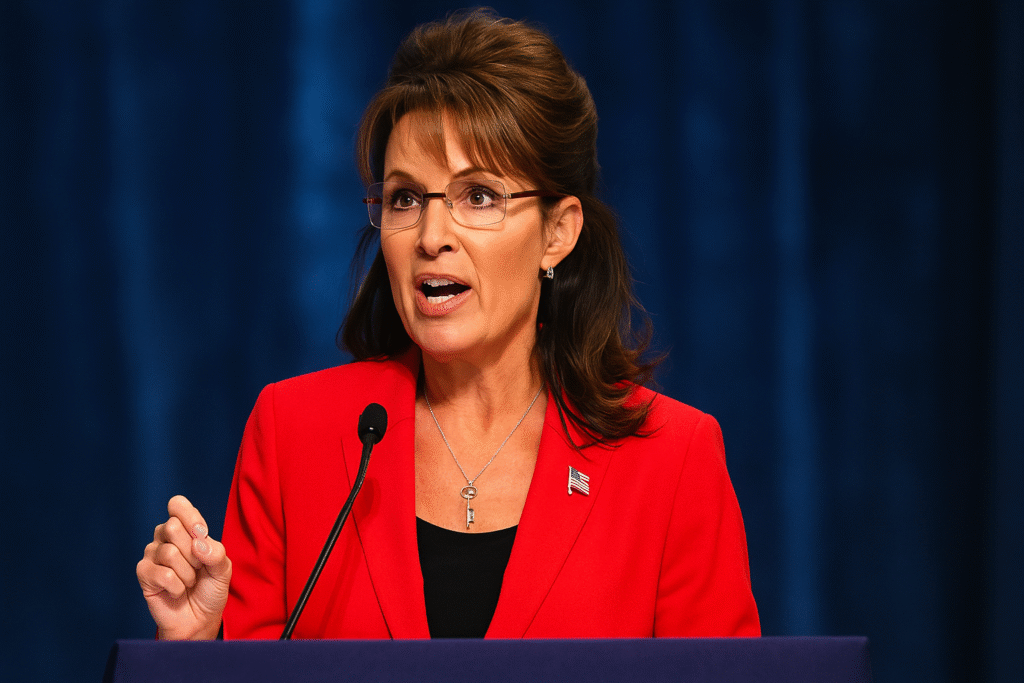
Sarah Palin testifies in her defamation case against The New York Times, claiming a 2017 editorial deeply damaged her reputation and political momentum.
Former Alaska Governor and 2008 Republican vice-presidential candidate Sarah Palin returned to the national spotlight as she took the witness stand in her closely watched defamation lawsuit against The New York Times. In emotionally charged testimony, Palin told the jury that the 2017 editorial at the center of the case “kicked the oomph” out of her political influence and credibility.
The Sarah Palin case revolves around a controversial editorial published by The New York Times that linked Palin’s political action committee (PAC) to a mass shooting in Arizona in 2011. The incident involved Jared Lee Loughner, who opened fire at a Tucson event, injuring several people and killing six. One of the victims was U.S. Representative Gabrielle Giffords.

Palin Claims Deep Personal and Political Damage
During her testimony, Sarah Palin claimed that the editorial caused significant emotional distress and tarnished her reputation in the eyes of the public. “I felt powerless,” Palin told the jury. “It was devastating. I had been maligned in one of the most respected newspapers in the country, and it hurt me professionally and personally.
”She also emphasized that the editorial had a direct impact on her ability to engage in political discourse and activism. “It kicked the oomph out of me,” Palin said, describing how the piece allegedly diminished her momentum and public engagement.
What the Times Editorial Said
The 2017 editorial was written in response to another mass shooting and drew comparisons to earlier instances of political violence. It referenced a map produced by Palin’s PAC that featured crosshairs over several Democratic congressional districts, including Giffords’. The Times initially claimed that there was a “clear link” between the imagery and the 2011 shooting.
However, after receiving widespread criticism, The New York Times issued a correction acknowledging that no such link had been established. The newspaper admitted that the editorial “incorrectly stated that a link existed.”
Legal Arguments and Media Law Implications
Sarah Palin’s legal team argues that the editorial was published with actual malice—a necessary standard in defamation cases involving public figures. They claim that the Times either knew the statements were false or acted with reckless disregard for the truth.On the other side, attorneys for The New York Times contend that the error was an honest mistake and was promptly corrected.
They argue that there was no intent to defame Sarah Palin and that her claims do not meet the legal threshold required for damages.This trial is being closely watched by legal experts and media organizations alike, as it could have broad implications for First Amendment protections and press freedom in the United States.
Public and Political Reactions
The trial has reignited debate about the responsibilities of the press and the rights of public figures to defend their reputations. Supporters of Palin argue that mainstream media often portrays conservative figures unfairly, while critics warn that a ruling in Palin’s favor could chill journalistic inquiry and editorial freedom.
Palin’s testimony has also sparked speculation about her political future. Although she has not held elected office since resigning as Alaska’s governor in 2009, her reemergence on the national stage suggests she may be considering a comeback—or at least seeking to reassert her voice in the public arena.
Conclusion: A Landmark Case for Media and Politics
As the trial continues, it remains to be seen whether Palin will succeed in proving her case. But regardless of the outcome, the lawsuit underscores the complex relationship between public figures and the media—and raises critical questions about accountability, truth, and freedom of expression in modern journalism.
For Sarah Palin, the verdict may determine not just financial compensation, but also the restoration of a political legacy she claims was unfairly damaged read more.