
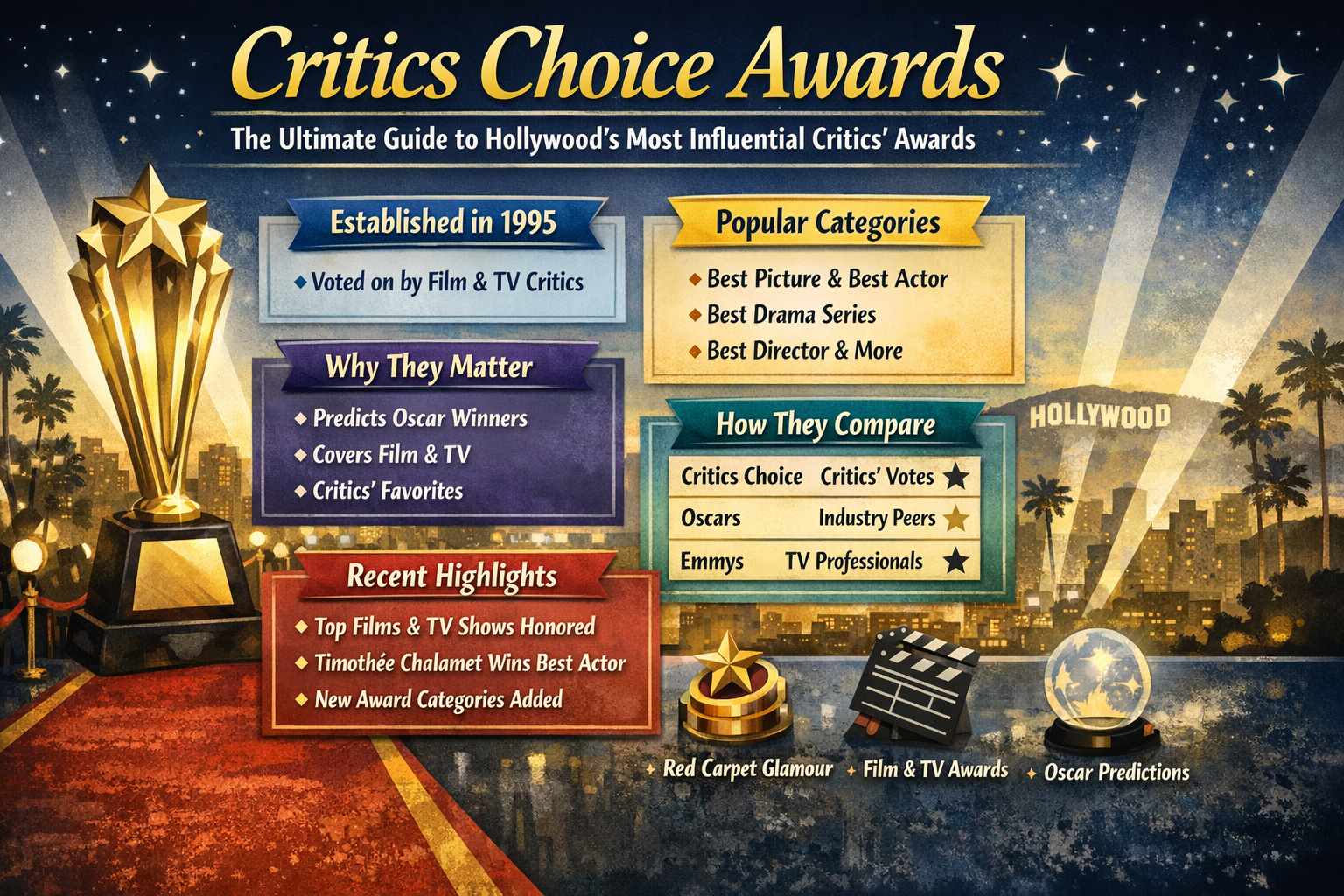
Critics Choice Awards explained in simple language: history, categories, how voting works, winners, highlights, and how the awards compare to the Oscars and Emmys. If you’ve ever wondered what the Critics Choice Awards are, why they matter, and what makes them different from other award shows, buckle up—this guide breaks it all down with clear info, real examples, and current context. By the time you’re done reading, you’ll know exactly why movie buffs, TV fans, and industry pros pay attention to this event each January.
Introduction — What Are the Critics Choice Awards?
The Critics Choice Awards are an annual set of honors given to outstanding achievements in film and television. They’re unique because they’re chosen not by industry insiders like the Oscars or Emmys, but by a large group of professional critics and entertainment journalists from across the United States and Canada.
So if you’ve ever heard critics say, “These are the year’s best movies or TV shows,” this award show is the formal result of their collective votes.
Why the Critics Choice Awards Matter
The Critics Choice Awards have grown into one of the most important awards on the Hollywood calendar for several reasons:
- They’re early: The ceremony typically takes place in early January, kicking off the awards season. (Critics Choice Association)
- They’re predictive: Often, their winners line up with subsequent awards like the Oscars—especially in major categories like Best Picture, Best Actor, and Best Actress.
- They cover both film and TV: While some awards focus on movies or television alone, the Critics Choice Awards celebrate excellence across both mediums.
- Critics pick the winners: Because real critics vote, the results often reflect critical consensus rather than just popularity.
But rather than just summarizing like other blogs, let’s dig deeper into the history and inner workings of this event.
A Quick History of the Critics Choice Awards
When It Started
The Critics Choice Awards traces its roots back to 1995 and was originally presented by the Broadcast Film Critics Association (BFCA).
Back then, it was just a film-only awards show, but over time:
- It expanded to include television awards.
- The BFCA eventually merged with the Broadcast Television Journalists Association to form the Critics Choice Association (CCA), which now oversees the awards.
Today, the Critics Choice Awards reflect a modern landscape of storytelling that includes streaming platforms, international content, and even genre films that sometimes get overlooked elsewhere.
How Winners Are Selected
Unlike viewer-voted awards or industry peer awards, the Critics Choice Awards are decided by working critics:
- Members must be professional film and/or TV critics reporting to large audiences (online or broadcast). (Critics Choice Awards)
- Critics submit written ballots during a nominating period.
- After initial nominations are set in December, voters choose winners whose names are revealed at the living awards ceremony in January.
This approach aims to give the awards legitimacy rooted in expertise rather than popularity or campaign budgets.
What Gets Awarded — Categories That Matter
The Critics Choice Awards cover a wide array of categories in both film and television, including:
🎬 Film Categories
- Best Picture
- Best Actor
- Best Actress
- Best Supporting Actor/Actress
- Best Director
- Best Original & Adapted Screenplay
- Best Animated Feature
- Best Foreign Language Film
- Best Visual Effects
- Plus newer categories: Best Casting and Ensemble, Best Sound, Best Stunt Design.
📺 TV Categories
- Best Drama Series
- Best Comedy Series
- Best Limited Series
- Best Talk Show
- Best Variety Series
- Best Foreign Language Series
- Best Animated Series
- Supporting and Leading Acting Awards in all categories.
This list is more extensive than many other awards shows and ensures that nearly every type of performance is given its moment.
The Critics Choice Awards Ceremony — What to Expect
Typically held in early January at Barker Hangar in Santa Monica, California, the Critics Choice Awards have become a star-studded event that includes:
- A red carpet with fashion highlights.
- Host-led entertainment, often by well-known comics like Chelsea Handler.
- Multiple presenters from film and TV.
- Winners giving emotional speeches that sometimes shape Oscar buzz.
The event is broadcast live on major outlets like E! and USA Network, and clips or highlights are shared across social platforms.
Recent Highlights — What Happened at the Latest Awards
At the 31st Critics Choice Awards in January 2026:
- One Battle After Another won Best Picture. (People.com)
- Timothée Chalamet took home Best Actor for Marty Supreme. (People.com)
- Notable performances and films like Sinners and Frankenstein won multiple honors. (EW.com)
- TV favorites also dominated, with shows like Adolescence and The Pitt sweeping major categories. (EW.com)
- Four new award categories were introduced to better reflect the craft behind storytelling. (Critics Choice Association)
These moments not only highlight current excellence — they also help set the tone for awards season conversations across the industry.
Critics Choice Awards vs. Other Awards Shows
| Award Show | Voters | Focus |
|---|---|---|
| Critics Choice Awards | Film & TV critics | Critical achievement across movies and TV |
| Academy Awards (Oscars) | Film industry peers | Film only |
| Golden Globes | Hollywood foreign press | Film & TV — but often celebrity-driven |
| Emmy Awards | Television professionals | Television only |
Unlike the Oscars or Emmys, which are voted on by members of industry bodies like the AMPAS or Television Academy, the Critics Choice Awards are based purely on critical evaluation — giving them a unique voice in the awards ecosystem.
Criticism and Controversy — Because No Award Is Perfect
Like any major award show, the Critics Choice Awards have faced scrutiny. Some critics and fans debate whether the winners truly reflect critical consensus or just mirror Oscar-bound frontrunners. Others question how much studio campaigning influences outcomes.
Still, the awards remain valued for highlighting standout work that sometimes gets overlooked elsewhere.
Predictions and Why They Matter
Since the Critics Choice Awards take place early in the year, they often influence:
- Oscar predictions
- Public opinion on standout performances
- Industry momentum for films and shows
The winners’ list frequently gives audiences an early glimpse at which performances and projects might dominate the rest of awards season.
Conclusion — Why You Should Care About the Critics Choice Awards
Whether you’re a casual viewer or a serious film and TV fan, the Critics Choice Awards serve as an important cultural marker. They:
- Champion critical excellence.
- Give early clues on awards season outcomes.
- Celebrate a wide range of creative talent.
- Reflect voices outside of industry insiders and fan voting alike.
So next time you see the Critics Choice Awards trending, you won’t just know what they are — you’ll know why they matter.
Read More:Critics Choice Awards