
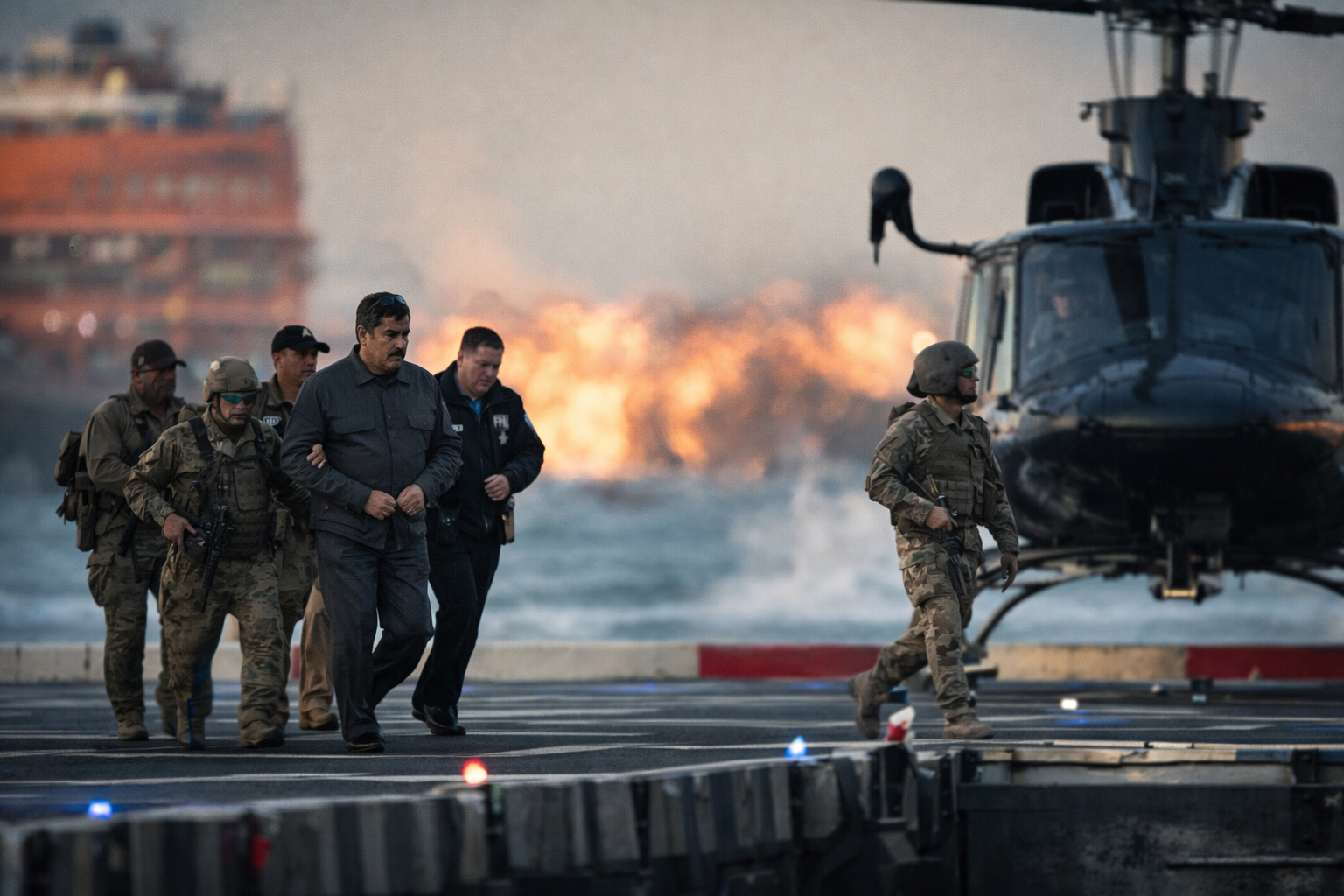
Nicolás Maduro travels to New York City to face court proceedings as global attention intensifies. Learn what this case means for international politics, U.S.–Venezuela relations, and the future of his leadership.
Introduction — A Shocking Legal and Geopolitical Moment
It wasn’t supposed to happen like this.
Venezuela’s embattled president, Nicolás Maduro, who has led the crisis-plagued South American nation for more than a decade, is now heading to a U.S. federal court in New York City to face serious criminal charges. This moment marks one of the most extraordinary legal and diplomatic turns in recent history — a foreign head of state captured in his own capital and transported to stand before an American judge. The story is still unfolding, but this guide will explain what’s happening, why it matters, and what the world — especially Venezuela and the U.S. — wants you to understand.(Anadolu Ajansı)
In this article, you’ll get:
- A clear timeline of events leading up to the court appearance.
- A summary of the charges and legal context.
- Reactions from governments, legal experts, and citizens.
- A comparison of existing news coverage — and deeper insights you won’t find elsewhere.
1. What Does “Maduro Heads to New York City Court” Actually Mean?
Earlier this month, U.S. forces executed a military operation in Caracas, leading to the capture of Nicolás Maduro and his wife, Cilia Flores. They were then transported to the United States, where they are now being held in the Metropolitan Detention Center in Brooklyn. On Monday (January 5, 2026), Maduro is scheduled to make his first appearance in federal court in Manhattan.(Anadolu Ajansı)
Key Points
- Maduro was captured in Caracas by U.S. forces and flown to New York City.(Moneycontrol)
- He and his wife are facing federal charges, including drug trafficking and alleged cooperation with gangs.(Anadolu Ajansı)
- His court appearance is not a typical extradition — he is already in U.S. custody.(NBC New York)
2. The Charges Maduro Faces: A Closer Look
The charges against Maduro and his wife are serious and far-reaching:
Allegations Include:
- Conspiracy to traffic massive quantities of cocaine into the United States.(Anadolu Ajansı)
- Accusations of narco-terrorism — linking political power and organized crime.(PBS)
- Other alleged criminal activities such as weapons-related allegations connected to the conspiracy.(Wikipedia)
The U.S. government claims this case is part of a broader effort to tackle transnational drug trafficking and violence, but critics worry it also reflects political motives at the highest level. Vendors of traditional media have covered the charges; this post goes further by explaining why these charges are framed the way they are and the legal challenges ahead.
3. Quick Timeline: From Caracas to Manhattan
Here’s how events unfolded:
January 3, 2026
- U.S. forces conducted a dramatic operation in Venezuela’s capital, Caracas, capturing Maduro and Flores during a nighttime raid.(Anadolu Ajansı)
- The couple was immediately transported to the United States.(NBC New York)
January 4–5, 2026
- The pair were held at the Metropolitan Detention Center in Brooklyn, awaiting their court appearance.(Wikipedia)
- On January 5, they were brought from the detention center to a Manhattan federal courthouse for their initial legal proceeding.(Reuters)
This rapid timeline — capture to court in just a few days — is unlike most international legal cases. Normally, extradition and diplomatic negotiations take months or years. The speed of these developments adds to the complexity and controversy surrounding the case.
4. Why Is the U.S. Involved — Legal and Political Context
This isn’t just a random legal case. It echoes decades-old indictments and geopolitical tension.
A Case Years in the Making
The U.S. Department of Justice first filed criminal charges against Maduro in 2020, long before the recent operation. These charges alleged a narco-terrorism conspiracy and illegal drug trafficking activities.(Wikipedia)
International Law and Sovereignty
Here’s where things get tricky:
- Heads of state usually enjoy sovereign immunity, which protects them from prosecution in foreign courts while in office.
- However, the U.S. government argues that it does not recognize Maduro’s legitimacy, especially after disputed Venezuelan elections and internal political crisis. This, in U.S. law, undermines claims to immunity.(PBS)
Legal experts have pointed out that this situation is unprecedented on such a scale, raising questions about diplomatic norms, jurisdiction, and the future of international legal accountability.
5. Reactions Around the World
The response to Maduro heads to New York City court has been dramatic and divided.
In the United States
- President Donald Trump described the operation as “bringing justice” and said the U.S. has a role in stabilizing Venezuela.(CBS News)
- Some U.S. political figures celebrate the move as targeting a criminal regime linked to violence and narcotics.(The Guardian)
- However, critics — including legal scholars — call it an unconstitutional overreach, arguing that Congress never approved military action against Venezuela.(PBS)
In Venezuela
- Loyalists condemn the capture as a kidnapping and illegal act of war.(Moneycontrol)
- The Venezuelan government’s interim president called for Maduro’s release and labeled the operation unlawful.
In New York City
- Community reactions vary widely:
- Some Venezuelan expatriates celebrate seeing a leader accused of corruption and crime held accountable.
- Others and local city officials criticise the operation as jeopardizing international law and public safety.(Moneycontrol)
This wide range of reactions illustrates how Maduro heads to New York City court isn’t just a headline — it’s a flashpoint in geopolitics, law, and human emotion.
6. What Happens in Court — What to Expect
Maduro’s first court appearance (an arraignment) will likely involve:
- Reading or summarizing the federal indictment.
- Entering a plea (typically “not guilty”).
- Judges setting dates for future hearings, bail decisions (unlikely), and calendar scheduling.
Legal experts say the arraignment will be procedural, but the legal battle ahead could take months or years, with complex debates over immunity, jurisdiction, and evidence.
Comparison to Similar Cases
Some observers have compared this to the trial of Panamanian dictator Manuel Noriega in 1989 — also brought to the U.S. by force to face drug charges — but there are unique differences here, especially in modern international law and the unprecedented involvement of a still-sitting head of state according to some interpretations.(Reddit)
7. Competitor Coverage vs. This In-Depth Guide
Let’s look briefly at three typical types of coverage online and how this post improves on them:
1. Basic News Snapshots
These articles report the fact that Maduro is in New York and has a court date.
👉 This guide adds clear context, a detailed timeline, and explanation of legal issues.
2. Short Explainers
Some sites outline charges but stop there.
👉 This guide adds background on past indictments, international law questions, and political reactions.
3. Opinion-Heavy Pieces
Commentaries often inject emotion or bias without grounded facts.
👉 This guide remains balanced, rooted in verified details, and explains implications clearly without sensationalism.
By combining factual reporting with deeper context, this guide helps you understand the “why” — not just the “what.”
Conclusion — A Moment That Matters
This story is far more than a courtroom spectacle. When Maduro heads to New York City court, it brings together questions of justice, international law, national sovereignty, and global politics in a way few events have.
Here are the key takeaways:
- Maduro is facing U.S. charges in Manhattan after a dramatic capture and transfer.(Anadolu Ajansı)
- The legal case raises questions about immunity, jurisdiction, and precedent.(PBS)
- Reactions vary widely — from celebration to condemnation — at home and abroad.(Moneycontrol)
As the case unfolds in the weeks and months ahead, it will likely reshape how the world thinks about accountability, leadership, and the limits of power.
Read More: A Shocking Legal and Geopolitical Moment