
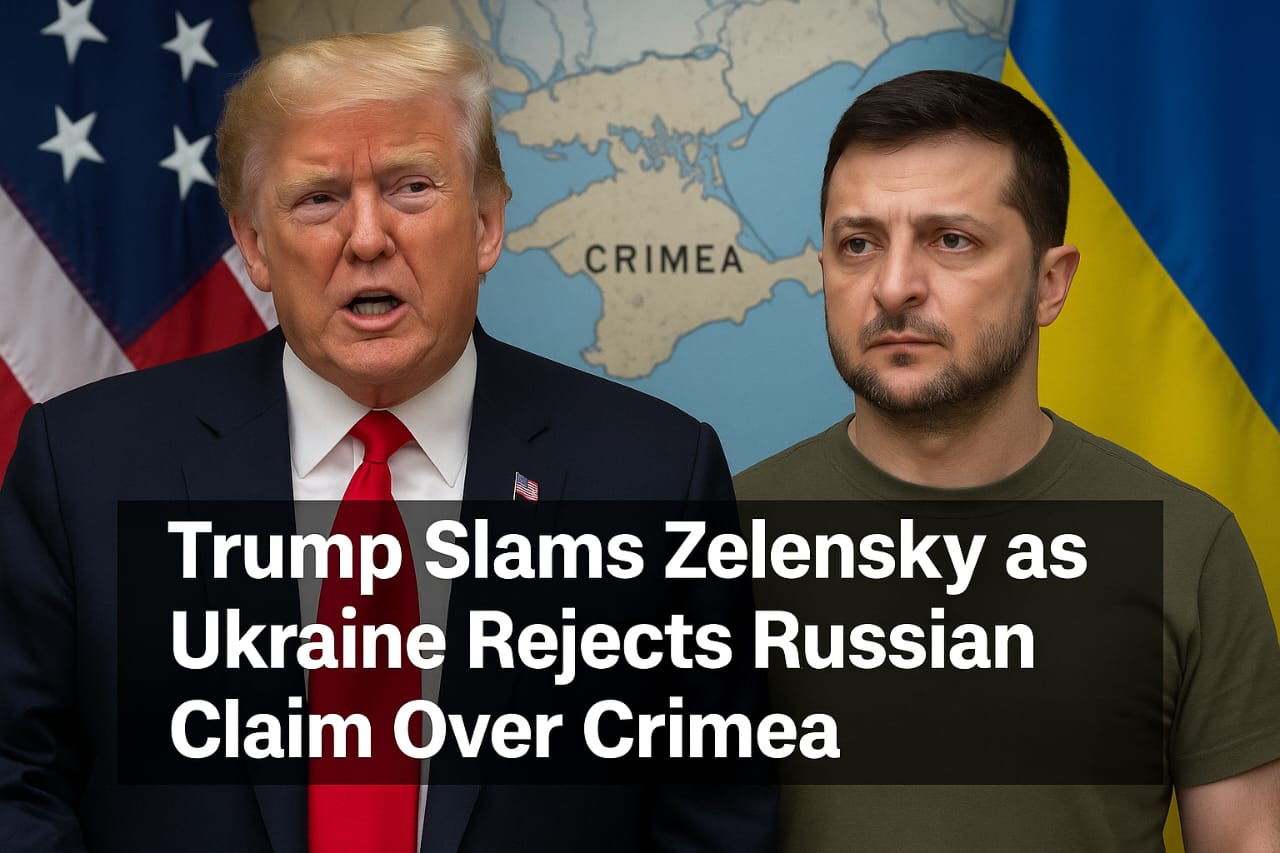
Donald Trump criticizes Ukrainian President Zelensky amid rising tensions, as Ukraine firmly rejects Russian sovereignty over Crimea. Get the latest updates on the geopolitical clash.
Tensions are once again flaring on the international stage as former U.S. President Donald Trump made headlines by sharply criticizing Ukrainian President Volodymyr Zelensky, following Ukraine’s continued refusal to accept Russia’s claim over Crimea. The controversial remarks have reignited debate over American foreign policy, U.S.-Ukraine relations, and the ongoing conflict between Russia and Ukraine.
Trump’s Latest Comments: “Zelensky Isn’t Being Realistic”
In a recent public statement and social media posts, Donald Trump accused President Zelensky of being “unreasonable” and “provocative,” suggesting that Ukraine’s unwavering stance on Crimea is prolonging the war and hurting diplomatic negotiations. Trump stated:“Everyone wants peace, but you can’t get peace if one side refuses to make compromises.
Crimea is already under Russian control — it’s a reality Ukraine needs to accept.”These remarks drew immediate backlash from international observers and political figures across the aisle, who view Trump’s comments as undermining Ukraine’s sovereignty and emboldening Russian aggression.
Ukraine’s Position: Crimea Is Not Negotiable
In response, Ukrainian officials swiftly reaffirmed their position: Crimea is part of Ukraine and its illegal annexation by Russia in 2014 remains a red line. President Zelensky has repeatedly emphasized that no territorial concessions will be made, especially when it comes to Crimea — a sentiment widely supported by the Ukrainian population and backed by most Western allies.“Ukraine will never trade freedom for peace,” Zelensky reiterated in a national address. “Crimea is Ukraine — that is non-negotiable.
A Deepening Divide on Foreign Policy
Trump’s remarks come amid growing division in American politics regarding support for Ukraine. While many Democrats and establishment Republicans continue to back military and financial aid to Ukraine, Trump and several right-wing figures have increasingly questioned the extent of U.S. involvement in the conflict.Trump’s stance also reflects his broader “America First” ideology, prioritizing domestic concerns and calling for reduced international commitments — even if it means shifting away from traditional allies.
International Reaction: Allies Reaffirm Support for Ukraine
Following Trump’s statement, NATO allies and EU leaders reaffirmed their unwavering support for Ukraine’s sovereignty and territorial integrity. European Commission President Ursula von der Leyen called the defense of Crimea’s rightful status “a cornerstone of international law.
”The U.S. State Department also distanced itself from Trump’s comments, confirming that official U.S. policy still recognizes Crimea as part of Ukraine, and condemns Russia’s occupation as illegal under international law.
Looking Ahead: The Stakes of the Crimea Question
As the war in Ukraine continues with no clear end in sight, the future of Crimea remains one of the most critical and complex issues in any potential peace negotiation. Trump’s statements underscore how domestic U.S. politics could significantly shape the global response to the conflict, especially as the 2024 U.S.
election looms and foreign policy becomes a key debate topic.Whether Trump’s critique of Zelensky will resonate with American voters — or backfire by appearing sympathetic to Vladimir Putin — remains to be seen. What is clear, however, is that Crimea continues to be more than just a piece of land: it is a symbol of sovereignty, resistance, and the high cost of war see more.